
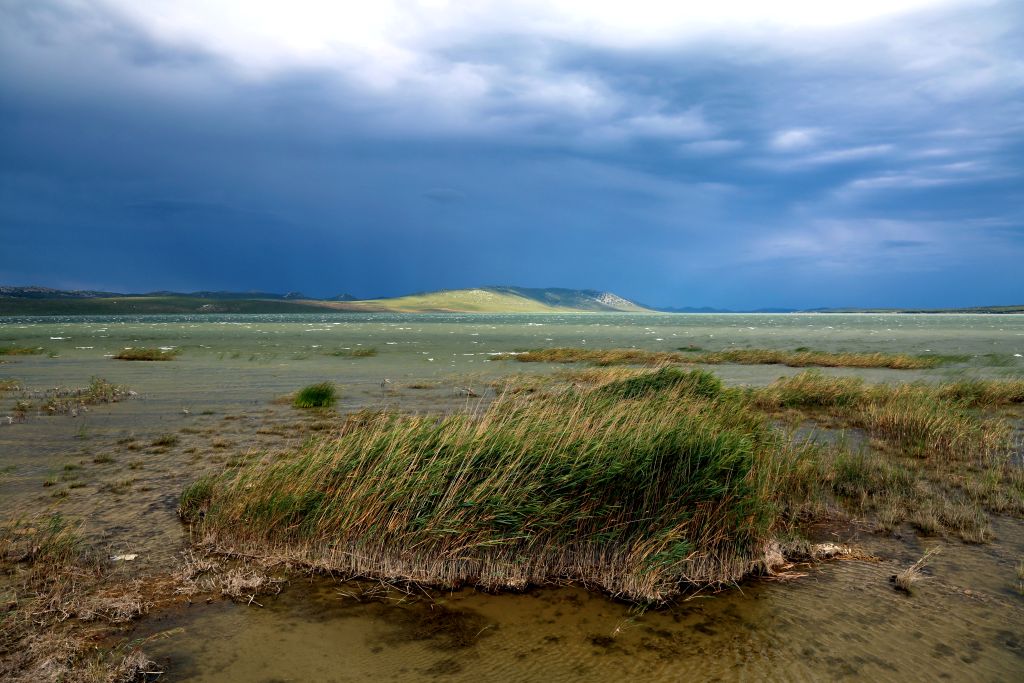
Vransko Lake is the largest natural lake in Croatia, measuring 13.6 km in length and between 1.4 and 3.4 km in width, with a surface area ranging from 29.8 to 30.02 km². It is a shallow cryptodepression situated in a karst basin, with the lake bottom reaching 3.47 m below sea level (b.s.l.). Water levels fluctuate seasonally between 0.02 and 2.25 m above sea level (a.s.l.), with the highest levels generally recorded in winter and spring and the lowest in summer and autumn.
The lake is separated from the Adriatic Sea by an 800–2,500 m-wide karst ridge. Due to seawater intrusion through the permeable karst, its waters are consistently brackish, with salinity ranging from 0.4 to 12 ‰. The significant seasonal variations in water level, together with changes in salinity, create specific environmental conditions that support a diversity of habitats and species.
The natural balance of Vransko Lake has been affected by human interventions. In the 18th century, the 800 m-long Prosika Canal was constructed to reduce the marsh area, primarily to control malaria and increase cultivable land. An irrigation system was subsequently developed in Vransko Field in the 1960s. These interventions have affected the quantity and quality of water entering the lake, contributing to the degradation of habitats and the species dependent on them.
Due to its rare natural habitats, freshwater springs and rich biodiversity, Vransko Lake and its surroundings were designated a Nature Park in 1999. A key feature of the park is its Ornithological Reserve, established in 1983 to protect the extensive and well-preserved reedbeds in the north-western part of the lake. The reserve has exceptional scientific and ecological value and is recognised as an Important Bird Area in Europe and a Ramsar site since 2013. Vransko Lake is an important hotspot for ornithofauna, with more than 260 bird species recorded, 102 of which nest within the park area. The lake and its surroundings also provide important resting and feeding grounds for numerous endangered European species, while more than 100,000 waterbirds winter on the lake.
The shallow depth of the lake allows for high light penetration and consequently high biological productivity, which can accelerate eutrophication and sedimentation processes. Water quality ranges from oligotrophic to mesotrophic, with some degree of eutrophication associated with the lake’s high productivity, introduced cyprinid fish species and nutrient inputs from agricultural fertilisation. Elevated nitrate concentrations have also been observed, primarily linked to intensive agricultural activities. In addition, increasing salinity has been associated with reduced inflows, declining water levels and rising sea levels.
Measures are implemented to reduce water turbidity and nutrient inputs, including nutrient-flow management and regulation of fish populations. Nature-based solutions (NbS) have also been applied at Vransko Lake. Reedbeds have been successfully used to improve the quality of water entering the lake through drainage canals, helping to retain nutrients and reduce the nutrient load that could otherwise contribute to eutrophication.